
Kindergarten in the City and in the Countryside - Differences in Access to Technology and Funding
Equal educational opportunities for children begin at the preschool level. However, in Poland, there are still significant differences between urban and rural kindergartens-both in terms of funding and access to modern technology. These disparities have a real impact on the daily lives of the youngest children, their development, and educational opportunities.
Kindergarten Funding - New Rules, Old Challenges
In 2025, Poland introduced new rules for education funding. The previous general subsidy was replaced by the "educational needs amount", intended to better reflect the real needs of local governments and institutions. These changes aim to improve the quality of preschool education, especially by increasing resources for children with special educational needs and enhancing the overall financial stability of local governments.
In practice, however, despite the increase in overall funding, differences between urban and rural kindergartens persist:
Expenditure on kindergartens in cities is up to 30% higher than in rural communes. This results from larger municipal budgets as well as higher maintenance and staffing costs in cities.
Rural kindergartens often have to cope with lower subsidies, which translates into more modest equipment, a limited range of extra-curricular activities, and difficulties in maintaining high-quality infrastructure.
Large cities invest in higher staffing standards-for example, providing an additional half-time teaching position per group compared to typical rural communes.
In the structure of public kindergarten expenditure, salaries dominate, accounting for nearly 75% of all costs. The remaining funds are spent on meals, building maintenance, or equipment investments-and it is precisely in these categories that the most significant differences between urban and rural institutions are observed.
Access to Technology - Digital Exclusion of the Youngest?
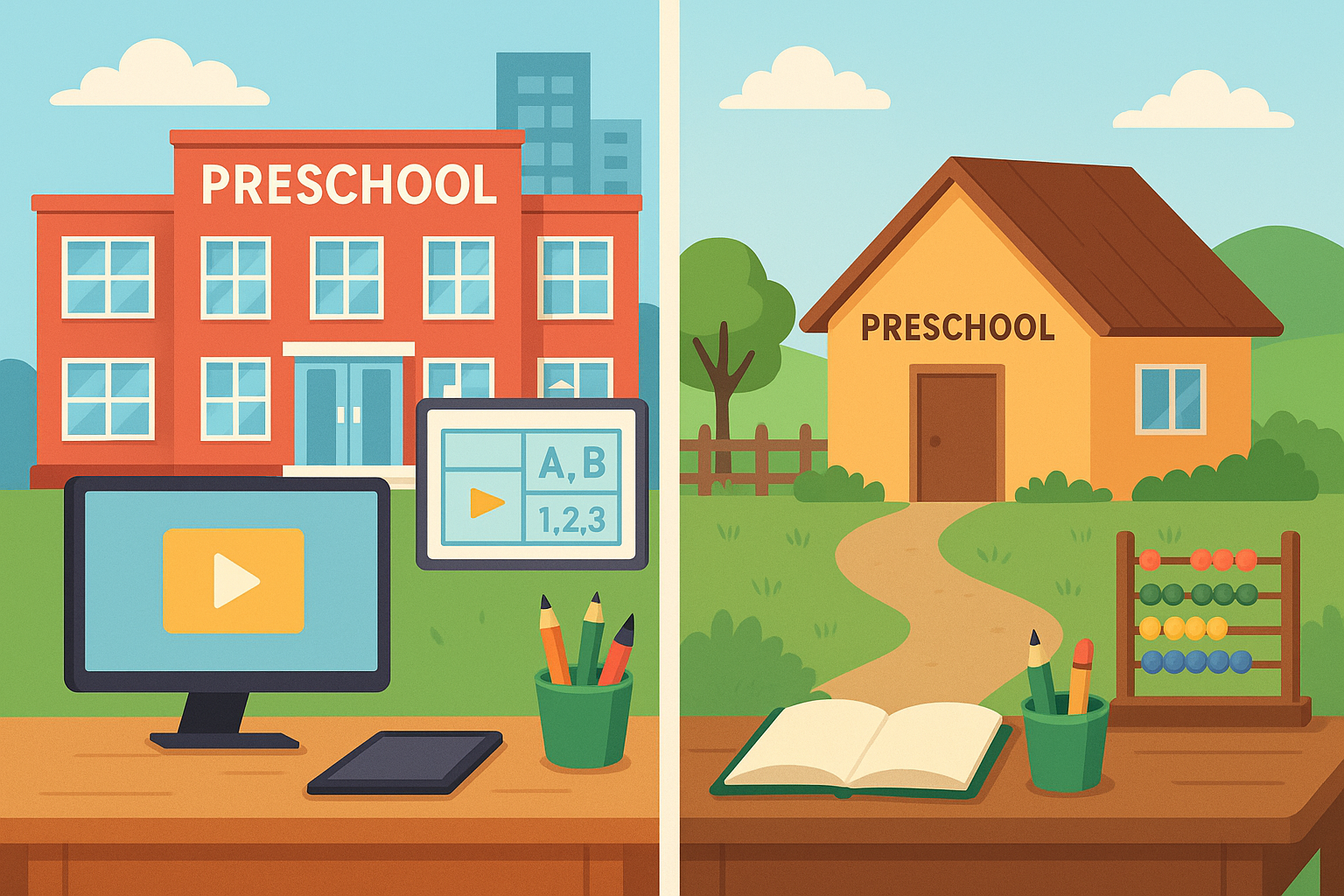
Modern educational technologies are becoming standard in many urban kindergartens. Interactive boards, tablets, internet access, and educational apps allow classes to be conducted in an engaging way and help develop digital skills from an early age.
In urban kindergartens:
Modern equipment is much more accessible. Institutions use municipal funds, EU programs, and support from local sponsors, allowing them to purchase multimedia equipment and organize teacher training.
A wide range of extra-curricular activities-children can participate in robotics, programming, language classes, or multimedia workshops.
In rural kindergartens:
Access to modern technology is limited-this is due to lower funding, difficulties in obtaining resources, and less support from local sponsors.
The range of extra-curricular activities is more modest, and teachers have fewer opportunities for training in new technologies.
It is worth noting that EU funds are playing an increasingly important role in financing preschool investments in rural areas, although their share in overall spending still does not exceed 10% nationwide. However, there are communes where preschool investments are almost entirely financed from structural funds.
Everyday Life of a Preschooler - What Do These Differences Mean?
Differences in funding and access to technology directly affect children's daily experiences:
Children in cities have greater opportunities to develop digital skills, participate in a richer range of extra-curricular activities, and benefit from better-equipped classrooms and modern playgrounds.
Children in rural areas often learn in smaller groups and have more contact with nature, but their opportunities to use modern educational tools are limited. The range of extra-curricular activities is more modest, and infrastructure often needs modernization.
Opportunities for Change
The changes introduced in 2025 to the education funding system are intended to increase resources for preschool education and better tailor them to the real needs of institutions. Additionally, EU programs and national grant initiatives support the development of preschool infrastructure, especially in rural areas. However, in practice, leveling the playing field requires not only more funds but also support in obtaining resources, teacher training, and systematic investments in modern equipment.
Sources
Centrum Verte, “Zmiany w finansowaniu oświaty w 2025 roku przez samorządy” [Changes in Education Funding by Local Governments in 2025]
Paweł Swianiewicz, Julita Łukomska, “Finansowanie przedszkoli z różnych źródeł” [Kindergarten Funding from Various Sources]
Najwyższa Izba Kontroli, “Finansowanie przez gminy przedszkoli publicznych i niepublicznych” [Funding of Public and Private Kindergartens by Local Governments]
Kancelaria Prezydenta RP, “Finansowanie przedszkoli w Polsce – stan obecny i wyzwania na przyszłość” [Kindergarten Funding in Poland – Current State and Future Challenges]
Fundusze Europejskie, “Poprawa dostępności i jakości edukacji przedszkolnej” [Improving Access and Quality of Preschool Education]
